Who is John Doe? Toronto cops seek answers in 1994 death plunge
· Toronto Sun
See more Toronto Sun on Google — save as a Preferred Source
Visit lebandit.lat for more information.
Sudden deaths happen all the time in the big city.
It comes with the territory. But if there is no identification, it all gets exponentially more difficult to find answers.
Such is the case of a man whose body was discovered on Sept. 23, 1994, downtown near the Rogers Centre. For 32 years, the John Doe has been unidentified and cops want to change that.
Cops don’t think it was foul play
Foul play is not suspected and the victim’s injuries are consistent with a catastrophic fall, about 40 metres. It isn’t clear whether he jumped or accidentally fell. His face was far too decomposed to create a composite
Det. Mike Kelly of the Toronto Police Service’s Cold Case Unit handles investigations concerning unidentified human remains. He is the guardian of 14 sets of remains that date from 1968 to 2023, including four homicides.
He said cops believe the dead man came from Germany.
“His face was unrecognizable so we couldn’t create a composite of what he may have looked like in life, there was no footprint of his life in Toronto,” Kelly said.
“And that’s one of our biggest challenges,” Kelly told the Toronto Sun. “Many of these cases are people who are from elsewhere.”
In two recent cases, Kelly noted, a man finally identified earlier this month as “Derek” was British, while the woman known as “Danforth Jane Doe,” who was murdered in 1936 and finally identified in July as 31-year-old Mary McLeod Moffat (nee Davidson), was Scottish born.
Man’s clothing distinctive
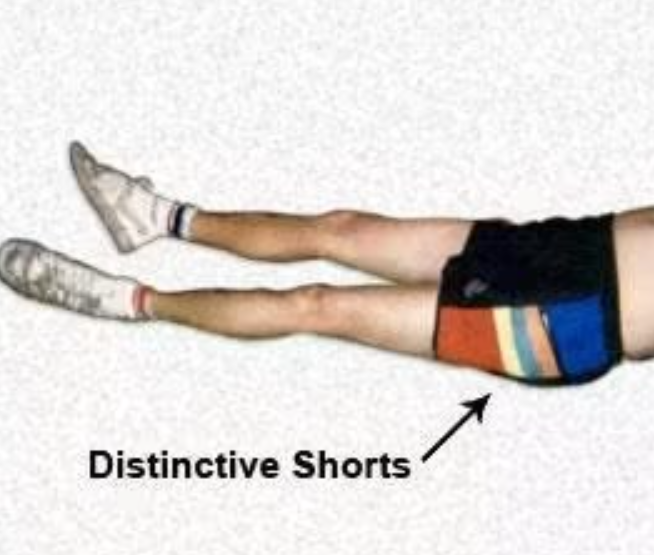
When the man’s body was found in 1994, he was wearing running shoes, a distinctive bathing suit sold in Hawaii, and a wool pea coat. Was the man swimming at the lake? Doubtful. Or had he taken a dip in a hotel or condo pool?
“There was nothing in his pockets. It’s a real mystery,” the detective added.
In an attempt to find his roots, Kelly deployed the game changing investigative genetic genealogy (IGG) that has given detectives a tenuous toehold. The results were that the dead man had links to the Lower Saxony region of Germany with cops believing that’s where his ancestors originated.
But Europeans and other nationalities have been slower to submit their DNA to sites like GEDmatch and FamilyTreeDNA. Kelly said the remains he’s overseeing in Toronto have ties to northeastern Italy, Guyana, Egypt, the Middle East and Armenia.
‘We want to bring closure to their families’
“We struggle when the victims are from abroad. Normally if the unidentified are Canadian, we identify them fairly quickly,” he said. “Family or friends will recognize them or report them missing. This just isn’t the case here.”
Cold case boss Det. Sgt. Steve Smith said his unit is dedicated to finally identifying the unidentified.
“We want to bring closure to the families of the victims,” Smith told the Sun. “They’ve gone for years without knowing what happened to their loved ones and we intend to do something about it.”
If you have any information, you can contact Toronto Police Service Missing Persons Unit at 416-808-7411 or [email protected] and quote Case #1994-161012.
Cops also suggest considering uploading your DNA to GEDmatch and FamilyTreeDNA. DNA could assist investigators in identifying John Doe or may aid in solving other unidentified person cases both in Canada and around the world.
@HunterTOSun