Ken Paxton Survived Indictment, Impeachment, and Scandal. Can He Survive a Senate Race?
· Reason
President Donald Trump has long been associated with lust. The 2016 election prominently featured "the Access Hollywood tape" in which he can be heard boasting about grabbing women "by the pussy." But recently, his affections have turned to men.
"I examined his ass," Trump said of Sen. Jon Husted (R–Ohio) at an October 17 rally. "I examined his ass. And then I looked at his shoulders; I looked at his feet; I looked at his hand; I looked at his jawline." He liked what he saw.
Visit grenadier.co.za for more information.
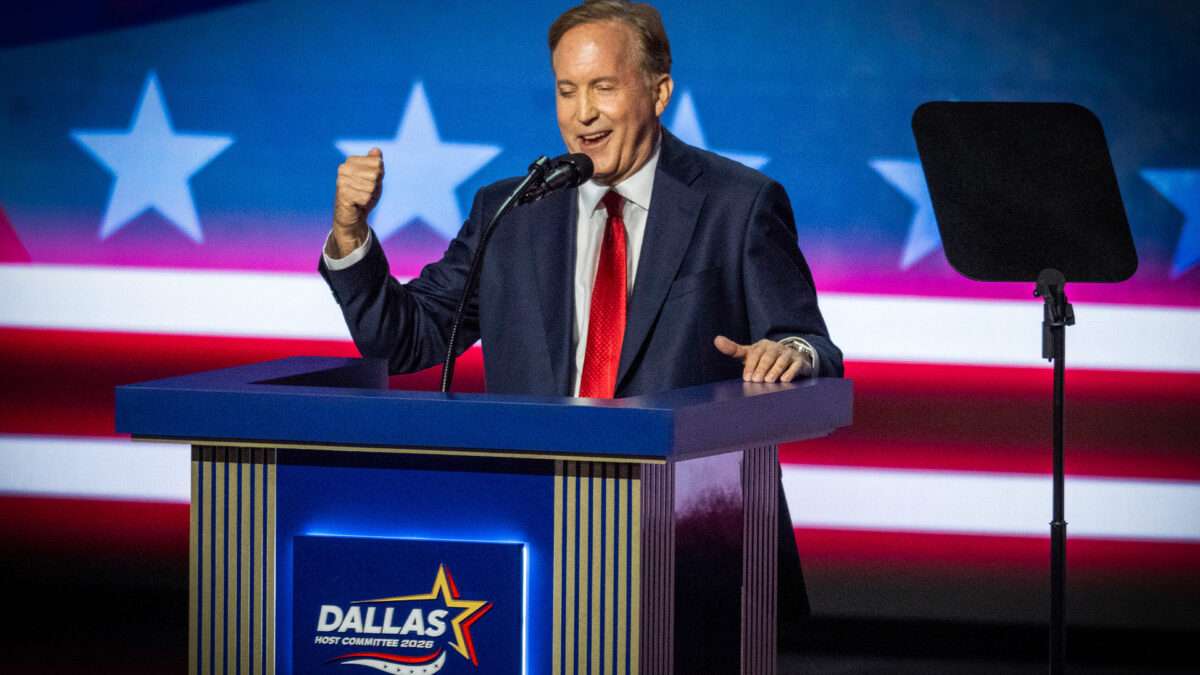
There is one candidate, however, whose ass appears to be safe from the president's admiration. "He may not dress right. He may not talk exactly perfectly, and he may not be the best-looking guy I've ever seen," Trump told the crowd on the first night of the GOP midterm convention in Dallas, Texas. Even still, "he deserves to be your next senator."
Such was the pitch for Ken Paxton, the Texas attorney general asking voters to promote him to the U.S. Senate. It has been a tough sell, much more so than is typical for a Republican fighting to represent Texas on the national stage. His opponent, state Rep. James Talarico of Austin, has often led in the polls in a place where a Democratic Senate victory would usually be relegated to liberal fever dreams. As A.G., Paxton has been dogged by an impeachment and by longstanding accusations, including from within his party, that his ethics compass is all but demagnetized.
There is another potential obstacle in his way, something Trump hinted at repeatedly in his Trumpian way over the course of that two-day convention. The main characters in the MAGA movement often have a kind of crass charisma—not necessarily a literal beauty, but certainly a talent for performance and presentation. This is a theme in populist movements for a reason: It's the people versus the elite, the outsiders versus the establishment, us versus them. So too can it serve as a helpful distraction when policies' practical results fail to match the promises made, as well as when allegations of corruption surface.
Paxton has the baggage with fewer obvious tools to combat it. And yet if one word best describes him, it may be survivor.
One Scandal After Another
Paxton had been Texas' top law enforcement officer for about six months when he became a defendant.
In July 2015, a grand jury indicted him on three felonies. The charges—two counts of first-degree securities fraud and one count of third-degree failure to register as an investment adviser—concerned work he had done while in the Texas House of Representatives. As state representative for part of Collin County, he convinced investors to put hundreds of thousands of dollars into Servergy, a tech startup, while allegedly failing to disclose that he was paid to attract those very investments.
A state attorney general showing up for a mug shot reverses the typical arrangement. Still, there were signs that this was on the way. In 2014, while Paxton was a state senator, the Texas State Securities Board disciplined him and fined him $1,000 for not completing the required registration to solicit investors. But while the criminal investigation delving into the full scope of alleged misconduct had been announced to the public, it was put on hold until after the election so as not to potentially sway the outcome.
It did not sway the next one either. Paxton was reelected in 2018. But that run-in with the law turned out to be just the beginning.
In 2020, the scandal that would come to define his career began to take shape. Several senior officials from Paxton's office went to the FBI to report him for what they said was an inappropriate and illegal relationship with his friend Nate Paul, an Austin real estate developer who was already under federal investigation.
Paxton, the officials said, had leveraged his office to help Paul in various legal disputes, such as foreclosure proceedings. They also alleged that the attorney general had deployed a special prosecutor to go after Paul's enemies. Paxton denied the accusations. He was reelected in 2022.
"These were upstanding people that Ken Paxton himself had hired because of their conservative bona fides. And yet they all left stating, 'I don't want to have anything to do with this guy,'" says one Republican official who worked alongside Paxton in the Texas government. "It's basically the story of Ken Paxton in my mind. If he doesn't cross the line and literally break the law, he constantly skirts it. And therein lies the problem.
"Now, that's not me saying that he doesn't break the law," the official continues. "I'm just saying that is kind of his MO."
The following year, the Republican-led Texas House of Representatives impeached Paxton for conduct related to the same scandal. The information aired during his trial, particularly as it related to his love life, arguably made the biggest impression on the public consciousness. Paul, it seemed, had set up a fake Uber account under the name "Dave P." It had a mysterious habit of summoning cars to pick up a passenger a block from Paxton's house so it could travel to the apartment of Laura Olson, Paxton's girlfriend.
This was complicated, because Paxton also has a wife, Angela Paxton, herself a member of the Texas state Senate. That body would go on to acquit Paxton of impeachment in September 2023. Angela announced two years later that she was filing for divorce "on biblical grounds."
As for that 2015 criminal indictment, the attorney general was set to go to trial in April 2024, after a series of protracted delays, when he cut a deal at the 11th hour. He would pay restitution and do community service, and in exchange, the prosecutors ultimately dismissed the charges. Had he been convicted, he faced decades in prison, and, per his own guidance, he would likely have been precluded from running for public office in Texas again as a felon.
Paxton declared his candidacy for the U.S. Senate the next year.
A Blunt Instrument
Paxton's knack for survival has long baffled onlookers. "The guy's ability to take shots and just keep moving on and stay in elected office is unlike anything I've ever seen in my career in 25 years of running campaigns," Ash Wright—previously a senior adviser to George P. Bush, who invoked the incumbent's mug shot in a 2022 bid to be attorney general—told the Associated Press in July.
How he does that is a matter of some mystery, given he does not possess the showmanship the president favors. One answer might provide a window into how the Republican Party has evolved in recent years. What Paxton may lack in stage presence, he makes up for in a willingness to use his office as a performative blunt instrument.
The attorney general's lengthy tenure has been consumed almost entirely by two categories: high-profile scandals and high-profile lawsuits. During the 2026 Senate primary, as he made his case that he should replace Republican John Cornyn, Paxton advertised his conservative bona fides with a statistic: He had "sued [President Joe] Biden over 100 times."
Those lawsuits covered quite a bit of ground. There was his attempt in 2020 to overturn the election results, which the U.S. Supreme Court rejected. But he did not always fare poorly. Within days of Biden taking office in 2021, Paxton sued to stop the then-president's 100-day pause on certain deportations, which a federal court granted. He secured enormous settlements against Meta and Google for alleged privacy violations, although neither company admitted wrongdoing.
Paxton has not lost steam. In 2025, he filed a lawsuit against former Rep. Beto O'Rourke, a Democrat, and his advocacy organization, Powered by People, over donations that supported Democratic lawmakers who left the state to block new Republican-drawn congressional maps. "Our Texan founding fathers—like our American founding fathers—took prior restraints on political speech out of the tool kit," a Texas appeals court later wrote, "when they enshrined the right to free speech in our Constitution." The year prior, Paxton filed suit against Annunciation House, a Catholic charity that shelters migrants in El Paso; one judge called his office's conduct in that case "outrageous and intolerable." Yet Paxton has succeeded in drawing out both cases with lengthy litigation. Even when he may lose the final battle, he often hamstrings his opponents for long periods, a different kind of victory.
Has that helped make Paxton nearly bulletproof? Maybe. But it is also a snapshot of the power of branding in this political moment and how he has leveraged it offstage. "How hard is it for anybody, any Republican, to go into the A.G.'s office and sue the president of the opposing party?" says the Republican former official. "It's just typical stuff, you know. It's nothing of this great political fighter that they think he is."
When it comes to the other category—those high-profile scandals—Paxton has repeatedly denied wrongdoing, casting his legal tribulations as politically motivated witch hunts. He is, he always insists, the victim, not the perpetrator. It may be another sign of how the political landscape has changed, particularly in the GOP, in that transgressions can become capital when marketed savvily.
In the May runoff with Cornyn, who has represented Texas in the Senate since 2002, Paxton won by 28 points.
Can the Survivor Survive?
Party conventions usually exist to formally nominate a president and vice president. Those trappings were still there in the GOP's midterm convention, though no one was being nominated. There were state delegations, their role entirely symbolic. There were balloons and sequins and Lee Greenwood, who introduced the president both nights by singing "God Bless the USA." Trump, of course, loves a good production.
You couldn't help but get the feeling sometimes that the event was largely mounted for Paxton. It took place in Dallas, after all, and his race was a constant part of the discussion.
"He is a weird-looking dude," Trump said. That time, he was referring to Talarico, whom he called "Talafreako." That comment didn't come with an endorsement. "I mean, I don't like talking about looks, but there's something missing there."
Talarico's general presentation has been a subject of fascination on the right throughout the race: his appearance, whether he likes football, accusations he's a vegan (he isn't). An ad run by Paxton deems Talarico "too low-T for Texas"—not macho enough.
How this mudslinging resonates may vary. "Policy is all that matters," Kyle Biedermann, who served with Talarico in the Texas House of Representatives, told me on the sidelines during the second night of the convention. "I don't care if he's a vegan. I don't care what he does. But his policies are horrible, terrible for our state." Those policies, he said, "are so socialist, so far, far left" that anything else is beside the point.
The night prior, when the president offered $5,000 to every American adult if Republicans won the midterms, a victory in Texas may have been at the top of Trump's mind. On closing night, during the president's second speech, Paxton was featured heavily again. Trump described how he had rehearsed for the moment with his circle. "I'll tell you what I was thinking about saying. I said, 'I don't like the way Ken dresses,'" he recounted to the audience. "And then I said, 'I don't really like the way Ken talks.' And then I said something that they really hated….I said, 'I don't really like the way he looks.'"
In the VIP section, Paxton smiled awkwardly. He is, after all, a survivor.
The post Ken Paxton Survived Indictment, Impeachment, and Scandal. Can He Survive a Senate Race? appeared first on Reason Magazine.